

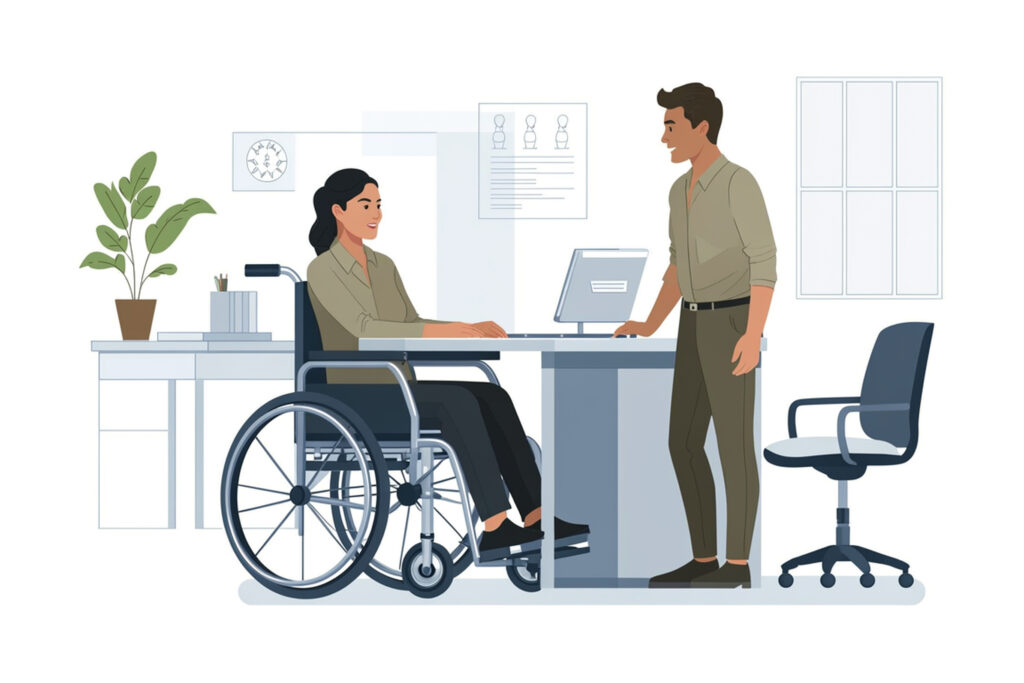
 According to the Bureau of Labor Statistics, 22.8% of people with a disability were employed. The Americans with Disabilities Act (ADA), which was enacted in 1990, is designed to protect those with a disability who are in the workplace or want to be. The ADA requires employers to make a reasonable accommodation to help employees with a disability to do their jobs and bars discrimination against job applicants who have a disability. Businesses with fewer than 15 employees are not covered by the employment provisions of the ADA. And a covered employer does not have to provide a reasonable accommodation that would cause an “undue hardship,” which is an action requiring significant difficulty or expense.
Special workplace situations
Telework as a reasonable accommodation
Telework was the norm during COVID-19, but return-to-work orders in most companies means that remote work arrangements are the exception to the rule. Telework can be:
- Full-time (no in-office work)
- Recurring or routine (regularly scheduled but less than on a full-time basis, such as 3 days a week)
- Situational (temporary in response to extenuating circumstances, such as recovering from a medical procedure)
Telework may be a reasonable accommodation for an employee with a disability. The EEOC has issued guidelines for federal agencies, but they are instructive for private-sector employers in determining when telework as a reasonable accommodation is appropriate. Here are some key takeaways:
- Telework that is primarily for the employee’s personal benefit, is not a recognized reasonable accommodation.
- An employee is not entitled to a preferred accommodation. An employer may offer an alternative. And the accommodation is not in perpetuity.
- There is no one size fits all. Employers must look at the facts and circumstances of the situation.
- Information from health care professionals is important in an employer’s decision making.
- Simple anxiety in an office setting may not be sufficient to warrant telework. The ADA “does not create a general right to be free from all discomfort and distress in the workplace, including anxiety.”
- A difficult or lengthy commute for an employee with a disability does not in and of itself warrant telecommuting. “[I]t is the employee’s responsibility to arrange how [they] will get to and from work.”
Handling employees who are addicts
Employees may be alcoholics or drug addicts. Do they warrant a reasonable accommodation? Again, it depends.
- Alcoholism. This is a covered disability under the ADA. Employers may have to adjust schedules to accommodate treatment, rehab, or counseling. But they don’t have to tolerate drinking on the job or lateness.
- Drug addiction. Again, for employees who are in recovery, providing time off for rehab can be a reasonable accommodation.
- Smoking/nicotine addiction. This is not considered a disability. No “smoke breaks” are necessary from the employer perspective.
Obesity
With the advent of GLP-1 and other weight-loss medications, obesity is being fought by many individuals. But obesity continues to be a problem for many others. As a general rule, obesity by itself is not considered to be a disability. There has to be an underlying medical condition for a reasonable accommodation to be needed. For example, in one case, an individual with a body mass of 47.5 (more than the threshold of 40 for Class III obesity) was not hired for a safety-sensitive position because of safety concerns. Ruling that the employer did not discriminate under the ADA, a federal appellate court said the obesity was not an “impairment.”
Mental health conditions
Anxiety, depression, PTSD, and ADHD are mental conditions that can be challenging for individuals and nearly 1 in 5 Americans experience some form of mental health issue each year. Do they rise to the level of a disability for which a reasonable accommodation should be made? Again, it depends on the situation. As mentioned above, simple job stresses, such as meeting deadlines, probably won’t be treated as a disability.
No retroactive accommodation. A federal district court said the fact that an employee’s who had clinical depression does not excuse past bad performance (unauthorized absences, excessive tardiness, and poor work performance), so the employer had non-discriminatory reasons for his termination.
Note: May is National Mental Health Awareness Month. The DOL’s Office of Disability Employment has some resources for employers to help build mental health-friendly workplaces. These include accommodation ideas for mental health conditions.
Final thoughts
In addition to the federal ADA, there may be state-level rules about accommodations to employees who have a disability, and they may apply to businesses with fewer than 15 employees. For example, California’s law applies for 5 or more employees, New York’s law applies for 4 or more employees, and New Jersey applies to all employers; there’s no minimum number of employees.
If you don’t know whether you have to make a reasonable accommodation or what that would be, seek guidance from an employment law attorney. Check out JAN (Job Accommodation Network) for guidance on workplace accommodations.
Additional information can be found in this list of blogs here.