

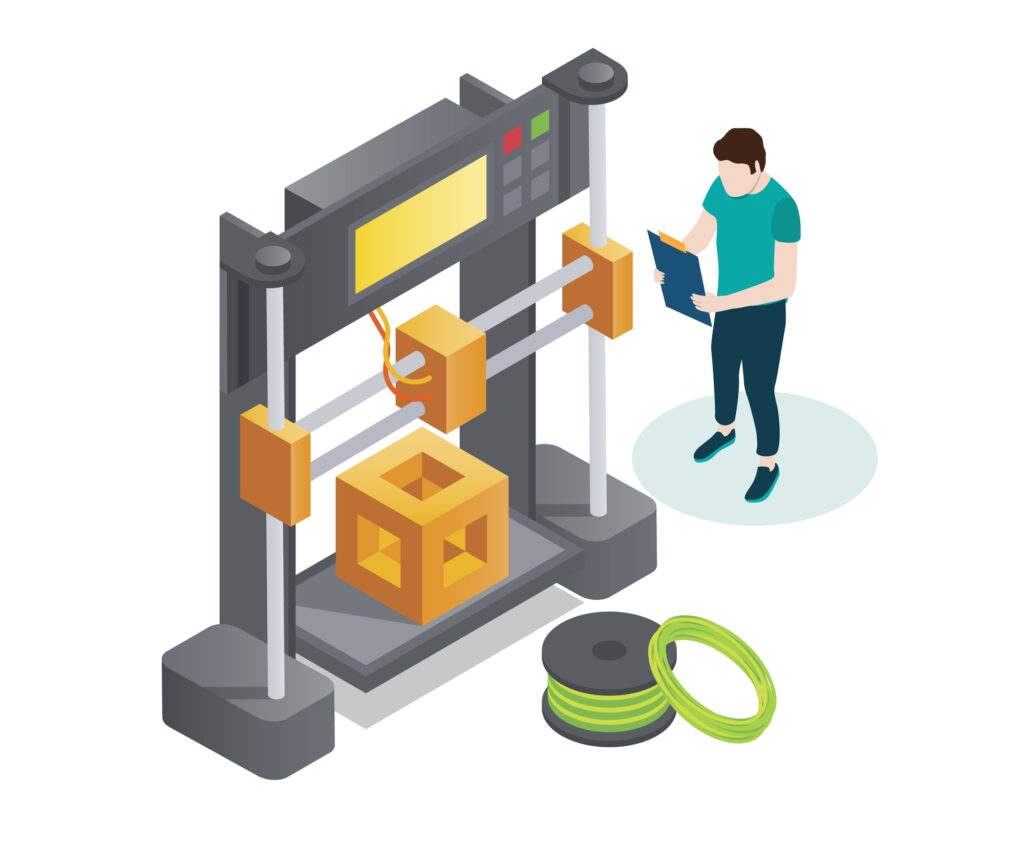
 Additive manufacturing—3D printing that builds objects layer by layer—is no longer just tools for rapid prototyping. They have matured into powerful production technologies that allow companies to operate with greater agility, efficiency, and precision. As industries face pressure to deliver innovation faster while controlling costs, additive manufacturing offers a practical and increasingly essential solution. It’s being used in aerospace, the automotive industry, medical technology, construction, and consumer goods (e.g., Adidas 4D running shoe lines).
Eliminating Tooling Constraints
One of the most significant cost drivers in traditional manufacturing is tooling. Producing molds, dies and fixtures requires considerable time and expense — and every design adjustment forces another round of rework. Additive manufacturing removes that barrier almost entirely. Engineers can transition directly from a digital model to a physical part without waiting for tooling to catch up. When design changes are needed, the updates occur digitally, which means the team is not tied to a physical tool that requires modification or replacement.
Even in cases where tooling is still necessary, additive manufacturing significantly speeds up the process. Many companies now print custom jigs and fixtures in-house rather than outsourcing them to machine shops. This process reduces lead times and frees up resources for higher-value work.
Material Efficiency and Smarter Resource Use
Traditional machining is inherently wasteful. Starting with a solid block of metal and cutting away material means companies pay for far more than they use. That becomes especially costly when working with advanced alloys or composites. Additive manufacturing flips that model. By building components layer by layer, only the required material is consumed. This approach dramatically reduces waste and lowers raw material costs, especially in industries that rely on titanium, Inconel or carbon-fiber-reinforced polymers.
Faster Lead Times and Accelerated Production Cycles
Speed may be the most compelling advantage of additive manufacturing. Traditional workflows often stall at multiple points, such as in tool production, machine scheduling, supplier coordination, or quality checks on complex assemblies. Additive systems eliminate many of these bottlenecks. Teams can move from CAD to physical part within hours, enabling faster iteration, quicker validation, and a smoother transition to final production.
The cumulative effect is a shorter development cycle. Products reach the market faster, engineering teams receive real-time feedback on their designs, and companies spend far less time waiting for external suppliers or internal machining capacity.
Part Consolidation That Simplifies Everything
Additive manufacturing excels in scenarios where multiple components can be combined into a single, integrated part. Instead of assembling a dozen individually machined pieces, engineers can redesign the component to be printed as one unified structure. This eliminates assembly time, reduces potential failure points, improves reliability and simplifies quality control.
This results in faster production and streamlined workflow from design to delivery. For industries such as aerospace and automotive, where both weight and reliability are crucial, part consolidation also enhances performance without introducing complexity.
On-Demand Production and Leaner Inventories
Another way additive manufacturing cuts costs is by reducing the need for extensive inventories. Rather than investing in storage space and tying up capital in spare parts that may never be used, companies can shift to on-demand production. Digital inventory replaces shelves of physical components, allowing organizations to print parts when needed and in the quantities required.
New Design Possibilities
Beyond cost and speed, additive manufacturing enables the creation of forms and structures that traditional methods cannot produce. Complex internal channels, organic shapes and lightweight lattice structures become feasible and affordable. These innovations can dramatically improve performance, such as by reducing weight, improving cooling efficiency, or optimizing stress distribution.
A Digital-First Workflow
Additive manufacturing naturally fits into modern digital ecosystems. Data flows directly from design software into production machines, making version control, quality tracking and repeatability easier to manage. This digital thread means changes propagate instantly, and teams can scale production up or down without major disruptions. It is a more flexible, software-like approach to manufacturing that supports continuous improvement.
Printing the Path Forward
3D additive manufacturing reshapes cost structures and production timelines. By removing tooling barriers, reducing waste, shortening development cycles, consolidating parts, and enabling on-demand production, it gives companies a level of agility that traditional manufacturing struggles to match. While 3D additive manufacturing does not replace every conventional method, its strategic integration can dramatically improve operational efficiency and accelerate innovation.
Find more information concerning the use of technology for your business in this list of blogs.